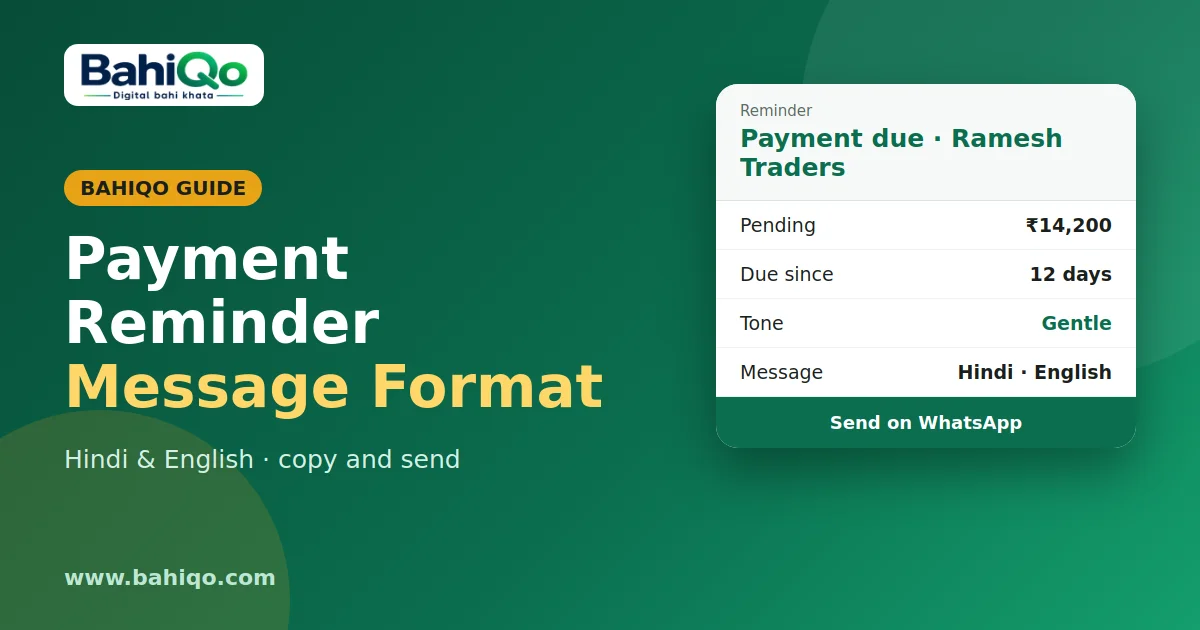
Most shopkeepers do not struggle to write a reminder. They struggle to send one. Asking a neighbour for money is socially awkward, and the awkwardness is why balances sit for months. A template removes the hardest part — deciding what to say — so the message goes out while the amount is still small enough to be paid easily.
The three stages of a reminder
Do not send the same message three times. Each stage should sound different, because the situation has changed. A customer seven days past due has probably forgotten. A customer sixty days past due has not.
Stage 1 — the gentle nudge (0–15 days)
Assume forgetfulness, not avoidance. Keep it short and give the exact figure.
English: Namaste {name}, this is {shop}. A friendly reminder that ₹{amount} is pending on your account from {date}. Please pay whenever convenient. Thank you.
Hindi: नमस्ते {name} जी, {shop} से। आपके खाते में {date} से ₹{amount} बाकी हैं। जब सुविधा हो, भुगतान कर दीजिए। धन्यवाद।
Hinglish: Namaste {name} ji, {shop} se. Aapke account mein ₹{amount} pending hai {date} se. Jab time mile, clear kar dijiye. Dhanyawad.
Stage 2 — the follow-up (15–45 days)
Add a date. A reminder without a date is a wish; a reminder with a date is a request.
English: Hello {name}, {shop} here. ₹{amount} is still outstanding on your khata. Could you please settle it by {due date}? Happy to accept part payment if that is easier.
Hindi: नमस्ते {name} जी, {shop} से। आपके खाते में ₹{amount} अब भी बाकी हैं। कृपया {due date} तक भुगतान कर दें। आंशिक भुगतान भी चलेगा।
Offering part payment matters more than it sounds. A customer who cannot pay ₹4,000 often can pay ₹1,000, and will pay nothing at all if the only option presented is the full amount.
Stage 3 — the final notice (45+ days)
Firm, factual, still polite. Never threatening — apart from being wrong, it guarantees you lose both the money and the customer.
English: Dear {name}, ₹{amount} has been outstanding on your account with {shop} since {date}. I have attached your statement. Please arrange payment by {due date} or let me know a date that works for you.
Hindi: {name} जी, {shop} में आपका ₹{amount} {date} से बकाया है। आपका पूरा हिसाब साथ भेज रहा हूँ। कृपया {due date} तक भुगतान करें, या मुझे बता दें कि कब कर पाएंगे।
What makes a reminder actually work
- Name the shop in the first line. A message from an unknown number about money gets ignored or reported. Recognition in the first second is everything.
- Give the exact figure and the date it started. Vague reminders invite vague replies.
- Attach the statement. A line-by-line record ends the "I already paid" conversation immediately.
- Send at a sensible hour. Late morning or early evening. Never before 9am or after 9pm.
- One reminder per week at most. Daily messages get you blocked, and a blocked number cannot collect anything.
- Offer a way to pay. A UPI ID or QR in the message converts far better than a message that only states a number.
What to avoid
Do not send reminders to a group. Do not name defaulters publicly — in India this can amount to defamation, and it destroys the trust the credit was built on. Do not use threatening language about recovery agents or legal action you have no intention of taking. And do not message someone who has asked you to stop; keep a note of who has opted out and honour it.
Timing: when to send
Send the first reminder on a weekday late morning, when people are awake but not yet out. Avoid Sunday evenings and the first two days of a festival — messages about money land badly then and are more likely to be ignored or resented. If your customers are salaried, the two days after the first of the month are by far the most productive window; if they are daily-wage or farming households, match the reminder to when money actually arrives rather than to your own month-end.
Frequency matters as much as timing. One reminder a week is plenty. Daily messages train people to ignore you and get your number blocked, and a blocked number cannot collect anything at all.
Handling the replies you will get
Three responses cover almost everything. "I already paid." Send the statement rather than arguing — nine times in ten the payment was real and simply never recorded, and you want to find that out. "I will pay next week." Accept it and record the date, then follow up on that exact day; a promise you follow up on is worth far more than one you let slide. Silence. Wait a week, send once more with the statement attached, then move to a phone call or an in-person conversation. Messaging has stopped working at that point and repeating it only wastes goodwill.
Keeping the figures right
Every template above depends on one thing: the amount being correct. A reminder for the wrong figure is worse than no reminder, because it hands the customer a reason to dispute the whole balance. Keeping entries in a digital udhar khata rather than memory means the number in your message is the number in your ledger, and you can attach the statement that proves it.