Every comparison written by an app company concludes that its own app wins. This one will not do that, because the honest answer is that these products are built for different shops and the right pick depends on how you actually trade.
The short version
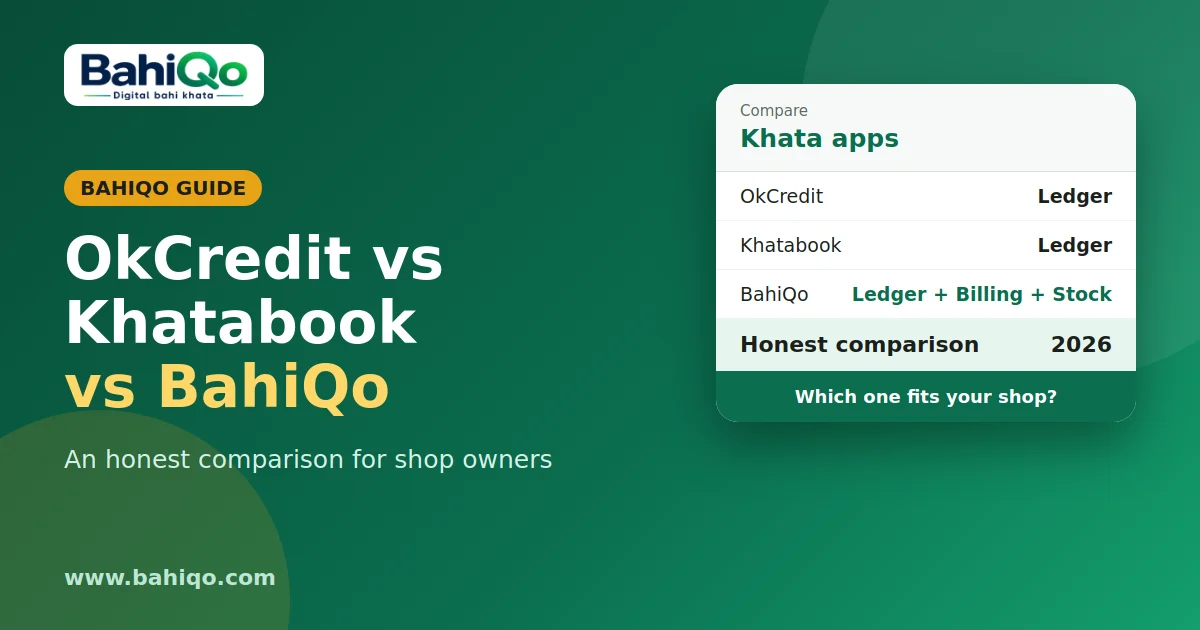
- OkCredit — the narrowest and simplest. If all you want is udhar tracking with reminders and you want the fewest possible screens, it is hard to beat.
- Khatabook — the broadest. Khata plus billing, staff accounts and reports. More to learn, more capable.
- BahiQo — the strongest at moving in and at keeping evidence attached to entries. Newer, so fewer features overall.
Where OkCredit wins
Simplicity is a real feature, not a consolation prize. OkCredit has fewer settings and fewer screens than anything else in the category, which matters enormously if the person recording entries is not comfortable with smartphones. It also has years of reminder infrastructure behind it and support in eleven languages.
If your requirement is exactly "track udhar, send reminder, get paid" and nothing more, OkCredit is a sound choice and switching away from it for feature reasons would be a mistake.
Where Khatabook wins
Khatabook went past the khata into billing, reports and staff accounts, and it has the largest user base in the category. If you need GST-ready bills alongside your credit ledger, or you want a shop helper who can log entries without seeing the whole financial picture, Khatabook covers ground the others do not.
The cost is complexity. A single-counter kirana store will use perhaps a fifth of it.
Where BahiQo wins
Moving your existing khata across. This is the honest differentiator. Most shops do not start from zero — they have years of balances in a paper book or a spreadsheet, and the fear of retyping it is why they never switch. BahiQo imports a CSV of parties and balances, shows every row with its validation result before anything is saved, skips duplicates, and lets you revert the entire batch if the mapping was wrong. Nothing else in this category treats migration this seriously.
Evidence attached to the entry. You can attach up to five photos or PDFs to a single ledger entry. When somebody disputes what they took in March, the bill is on the line itself.
Device control. Named devices, per-device logout, and login history. If your phone is stolen, you can cut its access from another device. Nobody in this category markets this, and everybody should.
Where BahiQo does not win
Being straight about this is more useful than pretending otherwise:
- Language coverage. Five languages against OkCredit's eleven and Khatabook's twelve. If you need Tamil, Telugu, Bengali, Marathi or Gujarati today, BahiQo does not have it yet.
- In-app UPI collection. OkCredit and Khatabook let a customer pay directly from the reminder. BahiQo does not yet.
- Billing and GST invoices. Khatabook and Vyapar do this; BahiQo is a ledger, not a billing system.
- Maturity. They are older products with larger support teams.
How to choose
Ask three questions. Do you need billing or only a ledger? If billing, look at Khatabook or Vyapar. Do you have existing data to move? If yes, the import quality matters more than any feature list. Which language does the person at the counter actually read? If it is not one of the five BahiQo supports, that decides it regardless of everything else.
A note on switching
You do not have to migrate everything at once. Set an opening balance per customer in the new app and record only new activity there. Within a month the old book is redundant and nothing was retyped. That approach works whichever of these you pick.