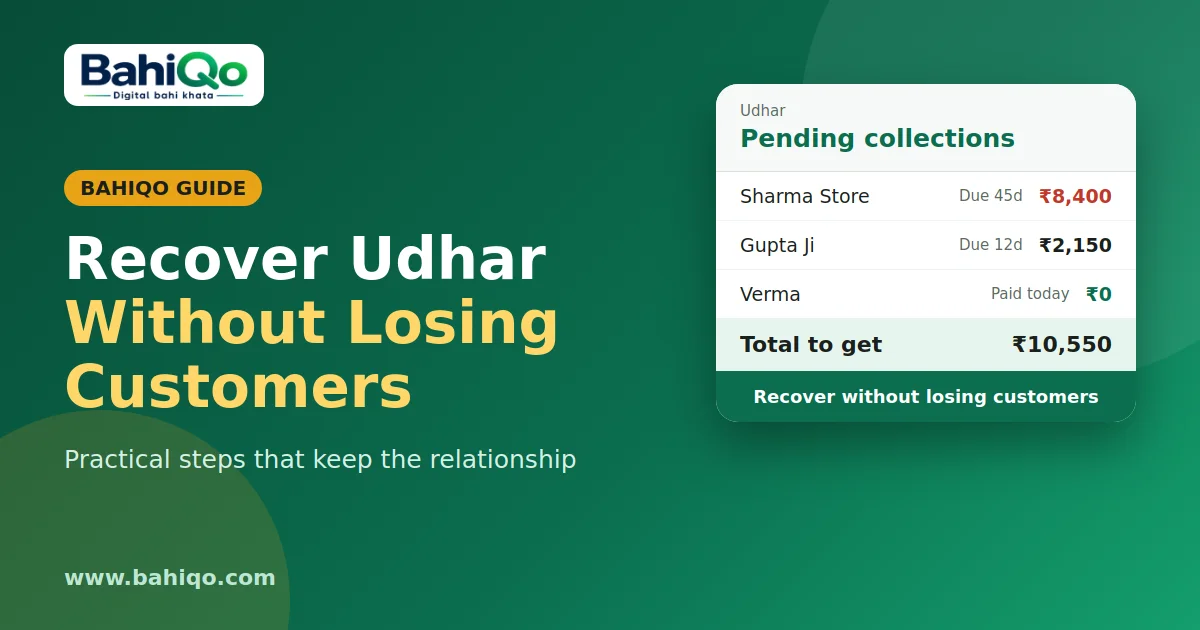
The instinct when a balance goes old is to push harder. In practice the shops that recover best push earlier and more gently, and almost never have to push hard at all. Recovery is a timing problem before it is a persuasion problem.
Ask early, while the amount is still small
A ₹500 balance at two weeks is an easy conversation. The same account at ₹6,000 and four months is a difficult one, and the difficulty is not the customer's stubbornness — it is that ₹6,000 is genuinely hard for them to produce at once. Every week you delay the first reminder, you make your own recovery harder.
Set a due date when you give the credit, not after it goes bad. A simple rule such as "settled by the 7th of next month" is enough, and it converts an open-ended favour into an arrangement with a shape.
Accept part payments, always
This is the single highest-return change most shops can make. A customer who cannot pay ₹6,000 can often pay ₹1,500 today, and will pay nothing if you insist on the full amount. Part payments also restart the relationship — once somebody has paid something, they are far more likely to keep paying.
Record each part payment on its own line with its own date. Do not net it off quietly against the balance, because the customer needs to see their payments acknowledged as much as you need to see the remainder.
Put the number beyond argument
Most "refusals" are really disputes. The customer genuinely believes they owe less than you say, usually because a payment was not written down or a purchase was recorded twice. Once the two of you disagree about the number, no amount of asking will move it.
This is what record-keeping buys you: not evidence for a court, but a statement you can put in front of somebody that shows every entry with its date. When the customer can see the line-by-line history — especially with the bill photo attached — the argument usually ends in one message.
The escalation sequence
- Day 7–15: a short, friendly reminder with the exact figure.
- Day 15–45: a follow-up with a specific date, and an explicit offer to accept part payment.
- Day 45+: a firm message with the full statement attached, asking either for payment or for a date.
- After that: a conversation in person, not more messages. At this point messaging has stopped working and continuing it only trains them to ignore you.
When somebody stops paying entirely
Three practical steps, in order. First, stop extending new credit — the most common way a small balance becomes an unrecoverable one is that the shop keeps giving. Second, agree a payment plan, even a slow one; ₹500 a month recovers more than a standoff. Third, mark the account so you and your staff can see the history before giving credit again.
Know when to stop. Chasing a ₹800 balance for six months costs more in time and goodwill than the ₹800 is worth. Write it off, mark the customer, and move on.
What not to do
Do not name defaulters publicly or in WhatsApp groups. Beyond being potentially defamatory under Indian law, it destroys the trust your entire credit model depends on — other customers see it and become wary of you, not of the defaulter. Do not threaten legal action or recovery agents you have no intention of using. Do not message somebody repeatedly after they have asked you to stop.
Prevention beats recovery
Set credit limits per customer and keep to them. Review overdue accounts weekly rather than monthly. Record every entry at the moment it happens rather than from memory at night. A digital udhar khata makes the weekly review a two-minute job instead of an evening with a notebook — and reviewing weekly is most of what separates shops that recover from shops that write off.