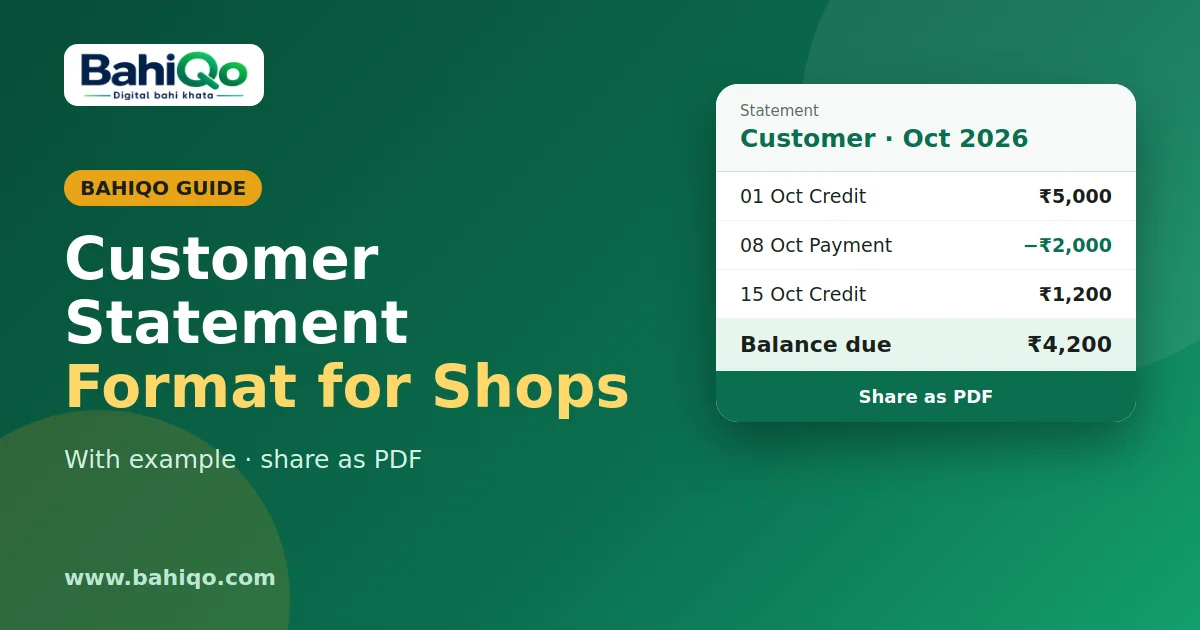
When a customer disputes their balance, the thing that resolves it is not a firmer message. It is a statement — a dated, line-by-line record that lets them check your figure against their own memory. Most shopkeepers send a total. A total invites argument; a statement ends it.
What a statement must contain
- Your shop name and contact details. The customer may be showing this to a family member who does not know you.
- The customer's name and mobile number. Confirms you are both discussing the same account.
- The period covered. "1 April to 30 June" — without it, a statement is ambiguous.
- The opening balance. What was outstanding on the first day of the period. This is the part most hand-written statements omit, and its absence is what makes them arguable.
- Every transaction in date order, each with date, description, and whether it was credit given or payment received.
- The closing balance. Opening, plus credit, minus payments, equals closing — visibly, so the arithmetic can be followed.
A worked example
SHARMA KIRANA STORE
Main Bazaar, Indore · 98XXXXXXXX

Statement for: Ramesh Kumar (97XXXXXXXX)
Period: 1 April 2026 to 30 June 2026

Opening balance (1 Apr)                        ₹ 1,200

Date        Description              Credit    Payment
05 Apr      Groceries                  850          -
12 Apr      Part payment                 -      1,000
28 Apr      Groceries + oil            640          -
09 May      Groceries                  410          -
22 May      Part payment                 -        800
14 Jun      Monthly supplies         1,150          -

Total credit given                           ₹ 3,050
Total payments received                      ₹ 1,800

Closing balance (30 Jun)                     ₹ 2,450
Notice that both part payments appear as their own lines with their own dates. Netting them off into a single figure is the most common mistake, and it is the one that makes customers feel their payments were not counted.
How to share it
A PDF is better than a photograph of a page: it is readable on any phone, it does not depend on your handwriting, and it looks like a record rather than a note. Sending it on WhatsApp is fine and usual — the customer already has that conversation open.
Send the statement with the reminder rather than after it. A reminder that includes its own evidence gets a faster and calmer reply than one that produces evidence only when challenged.
Common mistakes
- No opening balance. Without it the customer cannot verify anything and has to take your word for the starting figure.
- Payments netted off silently. Always show payments as their own lines.
- Vague descriptions. "Goods" tells the customer nothing. "Groceries + oil" lets them remember the day.
- No period stated. An undated statement cannot be reconciled against anything.
- Rounding. Round figures look estimated. Exact figures look recorded.
How often to send one
Two moments justify a statement. The first is monthly, for any customer carrying a balance large enough to matter to you — it keeps the number agreed continuously rather than letting a disagreement build for six months. The second is whenever a balance is disputed, in which case send it immediately rather than debating figures over messages.
There is a third case worth mentioning: send a statement when a customer finishes paying. A closing statement showing a zero balance costs you nothing, takes a second, and is remembered. It is the cheapest goodwill available to a shop that gives credit.
What to do when the customer disagrees
Ask them which specific line they dispute rather than defending the total. Almost every disagreement resolves to one entry — a payment they made that you did not record, or a purchase they believe was someone else's. Once the disputed line is identified, the conversation becomes a factual one about a single day rather than an argument about character.
If they are right, correct it visibly. A reversal or adjustment that stays in the ledger with its reason is far better than quietly editing the number, because next month they will remember that you corrected it fairly — and that memory is what keeps them paying you at all.
Producing statements without building them by hand
Every element above comes straight out of a properly kept ledger. If entries are recorded with their dates as they happen, the statement is a report rather than a document you assemble. BahiQo generates a statement for any customer or supplier over any date range, with the opening balance, every entry, and the closing figure — see the business ledger app page for how the customer and supplier sides work.